
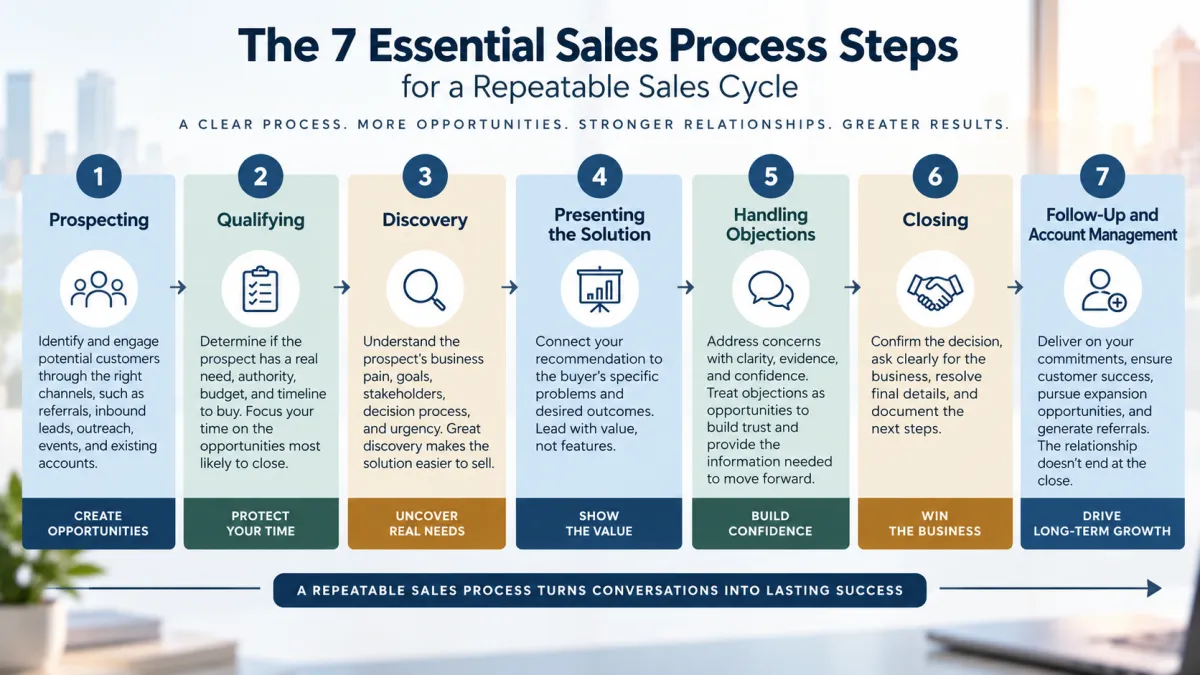
7 Essential Sales Process Steps Every Business Should Have
Most salespeople don’t lose deals because they lack talent. They lose deals because nothing in their day is built around moving opportunities forward consistently.
A repeatable set of sales process steps fixes that. Not a rigid script — a clear sequence that tells you exactly where each opportunity stands and what happens next.
Why Your Sales Process Matters More Than Your Sales Skills
Skill closes individual deals. Process closes deals consistently, month after month, regardless of how hectic the week gets.
Without defined steps in the sales process, you’re relying on memory and instinct. That works fine when your pipeline is thin. It breaks down fast when you’re managing 30 active accounts and your inbox won’t stop.
The 7 Essential Sales Process Steps
1. Prospecting
Every pipeline starts here. Define your ideal customer profile and identify where qualified prospects actually come from — referrals, marketing leads, cold outreach, or existing accounts.
2. Qualifying
Not every lead deserves your time. Before investing hours in a prospect, confirm they have the budget, authority, need, and a realistic timeline. Protecting your selling time starts here.
3. Discovery
This is where real selling begins. Ask the questions your competitors skip. Understand the business pain beneath the surface-level request.
4. Presenting a Solution
Stop pitching features. Connect what you offer directly to what they told you matters. A great discovery makes this step almost effortless.
5. Handling Objections
Objections aren’t rejection — they’re requests for more information. A defined process means you’re never caught off guard by the same concern twice.
6. Closing
If the previous steps were executed well, closing is a natural next step — not a high-pressure moment. Ask for the business clearly and directly.
7. Follow-Up and Account Management
This is where most salespeople fall apart. The deal is closed, but the relationship is just starting. Consistent follow-up protects retention, drives expansion, and generates referrals.
The Real Problem With Most Sales Cycles
Knowing the stages of a sales process isn’t the hard part. The hard part is executing them consistently when your inbox is overflowing, your calendar is packed, and every notification pulls your attention somewhere else.
A process without a system to support it is just a good intention.
That’s why the most successful salespeople pair their sales cycle steps with a daily workflow that keeps commitments visible and follow-up automatic — not dependent on memory. If you want to go deeper on building a process that actually holds up under real selling conditions, this complete guide to building a sales process that scales is worth your time.
How to Make Your Process Stick
The salespeople who hit quota consistently aren’t working harder. They’re executing a defined process inside a reliable system — one where nothing falls through the cracks because the system won’t let it.
Sell Sm@rter with Microsoft Outlook is a complete sales productivity system built around Microsoft Outlook that helps B2B salespeople do exactly that — manage follow-up, organize commitments, and protect selling time without adding another tool to the pile.
If your pipeline feels harder to manage than it should, the problem probably isn’t your process. It’s the system — or the lack of one — holding it together.
Take a look at how a better system could work for you.