

The Complete Guide to Building a Sales Process That Scales
How to turn inconsistent selling into a repeatable, coachable, measurable revenue system
A scalable sales process is more than a sequence of activities; it's the operating system that turns prospecting, qualification, discovery, proposals, follow-up, and closing into consistent execution. Most teams have a rough idea of their sales process steps in their heads, but few have actually written them down, tested them against real deals, or connected them to the sales pipeline stages reps see in the CRM every day. For companies with longer buying cycles, that gap shows up even more sharply in the b2b sales process, where more stakeholders and more steps mean more places for a deal to quietly stall.
The reason this matters is simple: growth exposes inconsistency. A founder can remember every conversation with every prospect. A ten-person sales team cannot. Without a defined process, one rep runs a thoughtful discovery call while another jumps straight to a proposal; one follows up the next morning while another remembers three weeks later. The revenue feels random because the approach is random. A written process, captured in a simple sales process template, replaces that guesswork with a shared standard everyone can follow and a manager can actually coach against.
This guide walks through that standard end to end: the core steps every process needs, how to build one from your own wins and losses, and how to turn it into tools your team will actually use - a working sales playbook for messaging and objection handling, and a sales process flowchart so anyone on the team can see at a glance where a deal sits and what has to happen next.
What Is a Sales Process? Sales Process Definition and Meaning
The simplest sales process definition is a defined sequence of steps a team follows to move a prospect from first contact to a closed deal. That definition matters because it separates selling activity from a selling system. A rep can make calls, send emails, hold demos, and write proposals without having a process at all. A process exists only when the team has agreed on a repeatable path, knows what each stage means, and understands what must happen before an opportunity advances. For a concise foundation, see What Is a Sales Process? A Simple Definition for Business Owners.
The sales process meaning ultimately comes down to consistency. When every opportunity is handled differently, results are difficult to diagnose and even harder to forecast. One prospect gets a thoughtful discovery conversation; another receives a premature proposal. One rep follows up the next morning; another remembers three weeks later. The revenue feels random because the approach is random.
A defined process removes unnecessary variability without turning good salespeople into robots. It creates a common map. Reps still use judgment, personality, and skill, but they use those strengths inside a structure that protects the critical moments of the sale.
What a scalable process must accomplish
Give every opportunity a clearly defined current stage.
Define the next meaningful action required to move the deal forward.
Set objective entry and exit criteria so stages are more than CRM labels.
Build qualification into the process so weak opportunities do not consume disproportionate time.
Create a reliable follow-up system that does not depend on memory.
Give managers enough structure to coach specific behaviors instead of asking vague questions such as “How is the deal going?”
Generate trustworthy pipeline data that can eventually support revenue forecasting.
This is why building a sales process is one of the highest-leverage moves a growing business can make. It converts individual selling knowledge into organizational capability.
The 7 Essential Sales Process Steps for a Repeatable Sales Cycle
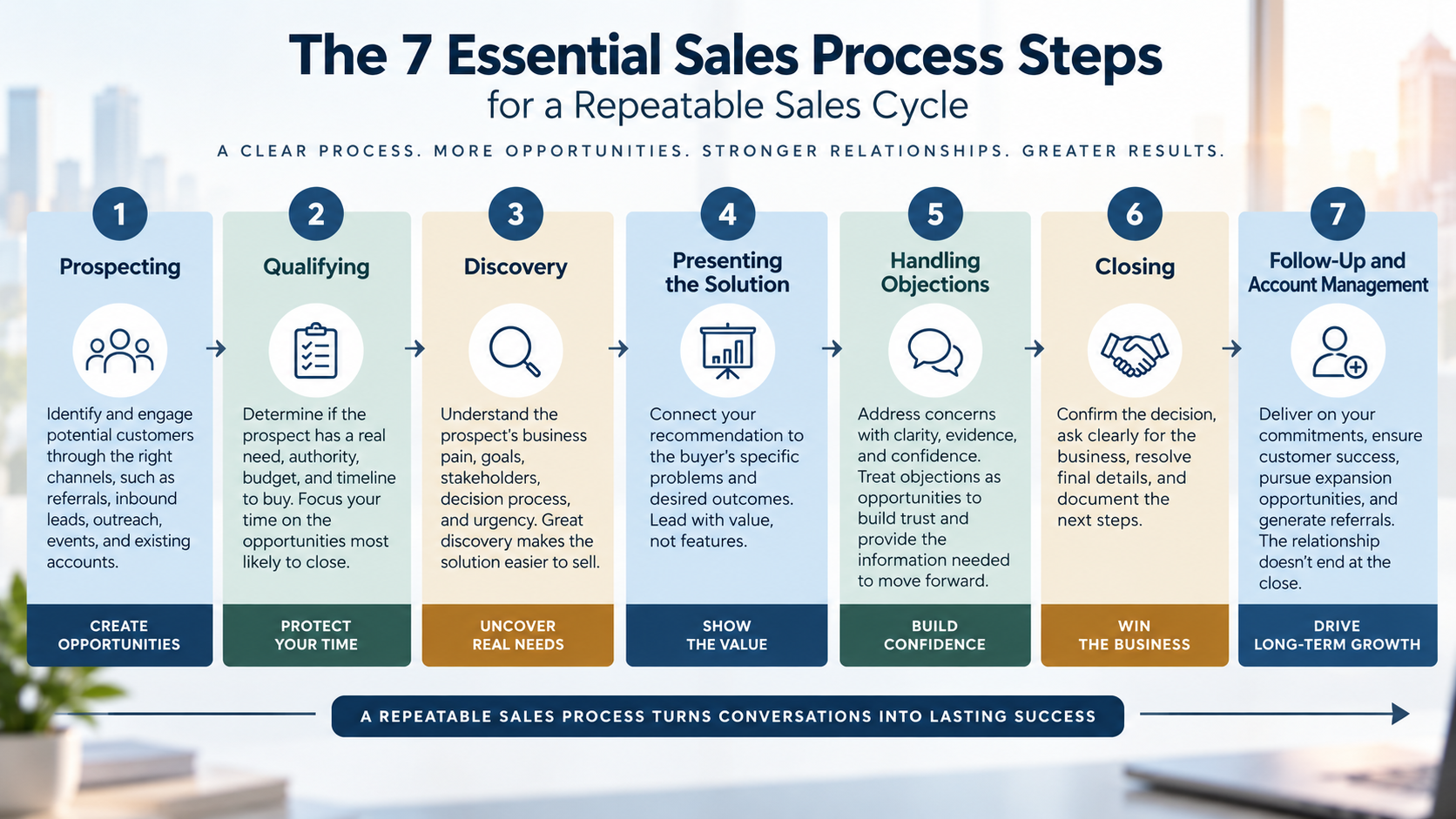
Most organizations can build a strong foundation around seven sales process steps. The labels can change, but the logic is remarkably consistent. The detailed companion article, 7 Essential Sales Process Steps Every Business Should Have, expands on each stage.
1. Prospecting
Prospecting is where potential opportunities enter the system. Define the ideal customer profile, the problems you solve best, and the sources that reliably produce prospects: referrals, inbound leads, cold outreach, LinkedIn, events, existing accounts, strategic partners, or another channel. The purpose is not merely to create a long list. It is to create enough relevant conversations to feed the rest of the process.
For a sales process for small business, this stage is especially important because limited selling capacity makes poor targeting expensive. The fewer hours available for selling, the more disciplined the business must be about who deserves outreach.
2. Qualifying
Qualification protects selling time. Interest alone does not make an opportunity. A prospect can respond enthusiastically, accept a meeting, and still lack the need, authority, money, or urgency to buy. Your qualification stage should establish enough evidence to decide whether continued investment makes sense.
A strong sales qualification process asks whether there is a real problem you can solve, whether the buyer has access to authority, whether the economics are realistic, and whether there is a credible timeline. A complementary lead qualification framework turns those judgments into consistent criteria instead of gut feel.
3. Discovery
Discovery is where real selling begins. The objective is not to race toward a pitch. It is to understand the prospect’s current situation, business pain, consequences, desired outcome, decision process, stakeholders, and urgency. Great discovery makes the later presentation easier because the solution can be connected directly to what the buyer said matters.
Discovery should also deepen qualification. Budgets change, priorities move, and decision-makers appear or disappear. Qualification is not a one-time gate; it is an ongoing assessment of whether the opportunity remains real.
4. Presenting the Solution
The presentation, proposal, or demo should be the logical result of discovery. Instead of leading with features, connect your recommendation to the buyer’s stated problems, desired outcomes, and decision criteria. A proposal that is not grounded in discovery is little more than a brochure with a price attached.
5. Handling Objections
Objections are often requests for additional confidence, clarity, evidence, or alignment. A scalable process does not improvise every response from scratch. It records recurring objections, identifies the real concern beneath them, and equips reps with questions, proof points, and response strategies.
6. Closing
Closing should not feel like a sudden high-pressure event. When the previous stages have been completed properly, the close is the next logical commitment. The rep confirms the decision, asks clearly for the business, resolves final details, and documents what happens next.
7. Follow-Up and Account Management
The signed agreement is not the end of the relationship. Follow-up protects retention, enables expansion, generates referrals, and creates future opportunities. In recurring-revenue or relationship-driven businesses, post-sale execution belongs in the sales process because the quality of the handoff affects the next sale.
These are the core steps in the sales process, but the most important lesson is not memorizing seven labels. The process works only when every step has a purpose, a required action, and a clear definition of progress.
How to Create a Sales Process From Scratch
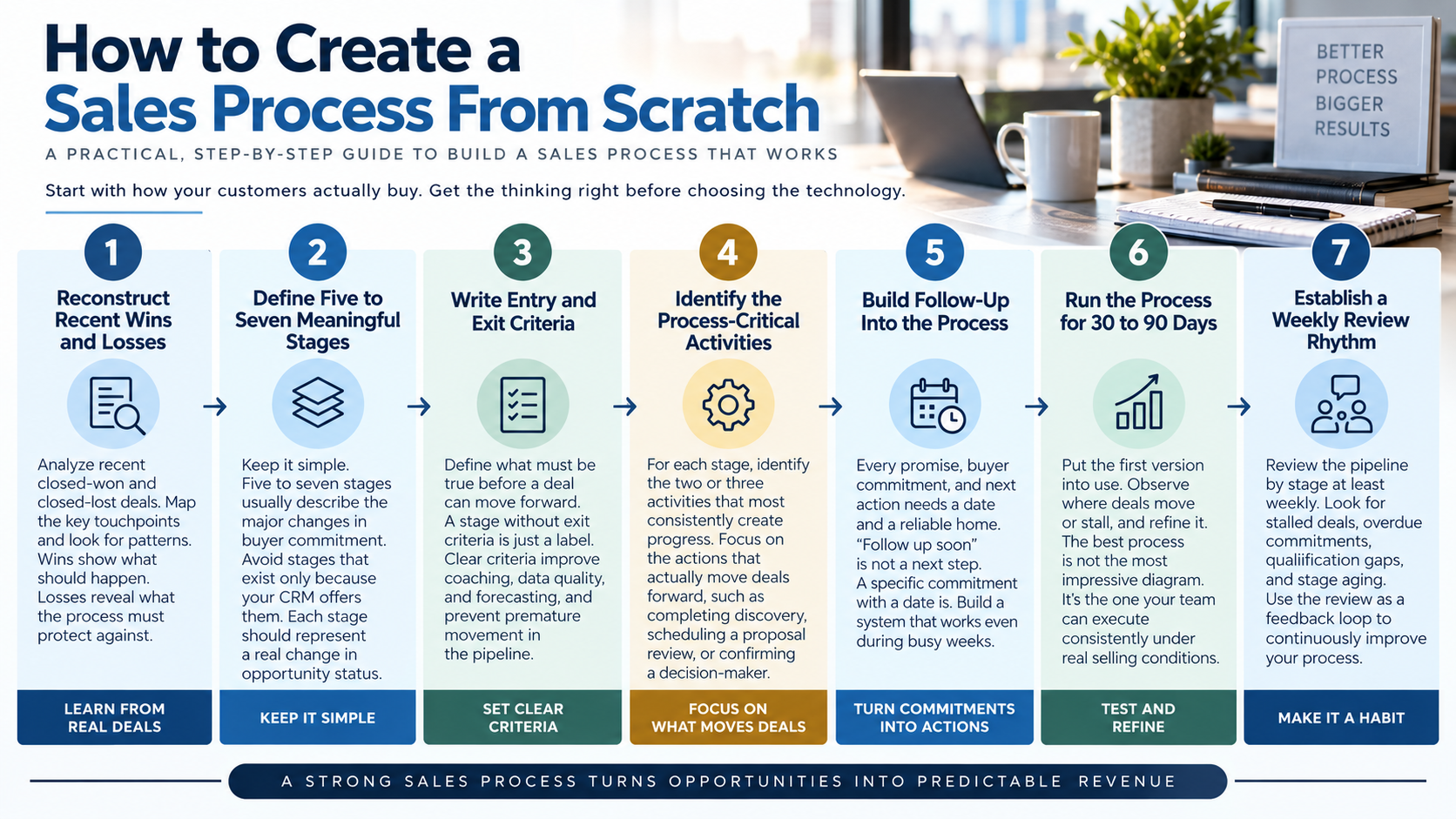
If you are learning how to create a sales process, resist the temptation to begin with software. Start with how your customers actually buy and how your best deals actually move. The companion guide How to Create a Sales Process From Scratch uses the same principle: get the thinking right before choosing the technology.
Step 1: Reconstruct recent wins and losses
Pull a small sample of recent closed-won and closed-lost opportunities. For each one, reconstruct the meaningful touchpoints from first contact through the final outcome. Look for recurring moments: qualification conversations, discovery meetings, demos, proposals, stakeholder reviews, legal or procurement steps, negotiations, and follow-up gaps.
Wins show you what should often happen. Losses show you what the process must protect against. If several deals died after a proposal was sent without a scheduled review, that is not merely a rep problem; it is a process-design clue.
Step 2: Define five to seven meaningful stages
Keep the first version simple. Five to seven stages are usually enough to describe the major changes in buyer commitment without creating administrative clutter. Avoid stages that exist only because your CRM offered them by default. A stage should represent a meaningful change in the status of the opportunity.
Step 3: Write entry and exit criteria
A stage without exit criteria is just a label. Define what must be objectively true before an opportunity can move forward. For example, a deal should not leave qualification because the rep feels optimistic. It might leave only after a legitimate business problem, buying role, approximate economics, and decision timing have been confirmed.
Exit criteria improve coaching, data quality, and forecasting simultaneously. They also reduce the tendency to push deals forward in the CRM simply to make the pipeline look healthier.
Step 4: Identify the process-critical activities
For each stage, identify the two or three activities that most consistently create progress. Do not document every possible task. Focus on the actions that materially affect movement: confirming a decision-maker, completing discovery, scheduling the proposal review, obtaining technical validation, or agreeing on a next commitment.
Step 5: Build follow-up into the process
Building a sales process means little if follow-up still depends on memory. Every promise, buyer commitment, and next action needs a date and a reliable home. “Follow up soon” is not a next step. “Call the CFO Thursday at 10:00 after the operations review” is.
This distinction is central to how to develop a sales process that survives busy weeks. The system has to work when the rep has thirty active opportunities, a full inbox, back-to-back meetings, and competing priorities.
Step 6: Run the process for 30 to 90 days
Do not wait for perfection. Put the first version into use, observe where deals actually move or stall, and refine it. The best process is not the one with the most impressive diagram. It is the one your team can execute consistently under real selling conditions.
Step 7: Establish a weekly review rhythm
Review the pipeline by stage at least weekly. Look for stalled deals, overdue commitments, missing next actions, qualification gaps, and stage aging. The review is not only for inspection; it is the feedback loop that improves the process itself.
Use a Sales Process Template to Turn Ideas Into a Working System
A sales process template converts an abstract process into something a rep can actually follow. The simplest useful version is not a 40-page manual. It can begin as a four- or five-column sales process worksheet. For a focused starting point, use the ideas in Free Sales Process Template: Build Your Playbook in Under an Hour.
A practical free sales process template structure
Stage | Entry Criteria | Critical Action | Buyer Commitment | Exit Criteria | Follow-Up |
Prospecting | Fits target profile | Initiate relevant outreach | Engages in conversation | Meeting or qualification conversation set | Dated next touch |
Qualification | Conversation started | Confirm fit, need, authority, economics, timing | Agrees there is a problem worth exploring | Meets qualification threshold | Discovery scheduled |
Discovery | Qualified enough to invest time | Diagnose current state, impact, desired outcome | Shares meaningful business context | Problem and desired outcome are clear | Solution review scheduled |
Proposal / Demo | Discovery complete | Connect solution to stated priorities | Evaluates recommendation with required stakeholders | Decision path and open issues are known | Review meeting scheduled |
Negotiation | Buyer sees value | Resolve objections, terms, risk and approvals | Confirms path to decision | Commercial and decision issues resolved | Decision date confirmed |
Closed Won / Lost | Decision reached | Document outcome and next actions | Signs, declines, or defers | Final status recorded | Handoff, nurture, or postmortem |
This is a sample sales process, not a universal prescription. Change the stages to match the buying journey. The important part is that every row answers the same questions: What has to be true before the stage begins? What action matters most? What does the buyer need to do? What proves the stage is complete? What happens next if the buyer does not respond?
A free sales process template becomes valuable only when it is used on live opportunities. Run every new deal through the worksheet for a month. Where reps repeatedly struggle to answer a column, the process is probably unclear.
Sales Pipeline Stages: How the Process Becomes Measurable
Your sales process describes how selling should happen. Your sales pipeline stages show where current opportunities are inside that process. The distinction matters. For a deeper treatment of the stages of a sales pipeline, see Understanding Sales Pipeline Stages: From Lead to Closed Deal.
Pipeline stages explained properly are not simply buckets for reporting. They are decision points. A useful stage tells the rep what is true now, what must happen next, and what evidence is required before the opportunity advances.
Common stages of a sales pipeline
Lead / Prospect — a potential buyer has entered your world, but fit has not been established.
Qualified Opportunity — enough evidence exists to justify active selling time.
Discovery / Needs Analysis — the business problem, impact, desired outcome, and decision context are being developed.
Proposal / Presentation — the buyer is evaluating a specific recommendation, demo, or proposal.
Negotiation / Commitment — final objections, commercial terms, approvals, or risk questions are being resolved.
Closed Won / Closed Lost — the opportunity has reached a final outcome and should be documented accordingly.
Sales funnel stages versus pipeline stages
Sales funnel stages are often used to describe the broader progression from awareness to consideration to decision, while pipeline stages are usually operational labels attached to specific opportunities. Both views can be useful, but a sales team needs enough precision to know what the buyer has actually done, not merely what the seller hopes will happen.
That buyer-centered perspective is explored further in The Sales Stages Explained: What Happens at Each Step of the Funnel. Each stage should reflect where the buyer is in the decision process and what the buyer needs next to feel confident moving forward.
Every open opportunity needs a dated next action
A pipeline is not healthy merely because it contains many deals. Every active opportunity should have a concrete next action with a date. If no one can say what happens next and when, the opportunity is not being managed; it is being stored.
This is where pipeline hygiene becomes a behavioral discipline rather than a CRM exercise. Clear next actions expose stalled deals early, improve follow-up, and make pipeline reviews far more useful.
Qualification: The Gate That Protects the Entire Sales Process
One of the most expensive process failures is allowing weak opportunities to travel too far. Unqualified deals consume discovery time, proposal effort, technical resources, management attention, and forecast capacity. A scalable process therefore treats qualification as a gate and a continuing discipline.
A simple lead qualification framework
Need: Is there a real problem your solution can solve?
Authority: Is the person involved able to decide, influence, or connect you to the people who can?
Budget or economic fit: Is the investment realistic?
Urgency or timeline: Is there a credible reason and timeframe for action?
These four questions are closely related to BANT sales — Budget, Authority, Need, and Timeline. BANT is useful as a qualification tool, but it should not become an interrogation. Work the information into a natural discovery conversation about the buyer’s situation, priorities, decision process, and desired outcome.
Qualification is not a one-time checkbox
A lead that looked strong in January can be weak in March. Budgets freeze. Executives leave. projects get reprioritized. Competitors enter. Timelines move. Build qualification check-ins into meaningful touchpoints so the opportunity remains supported by current evidence.
This also keeps the pipeline honest. Carrying weak deals because an uncertain opportunity feels better than an empty pipeline creates false confidence and damages forecasting.
B2B Sales Process: Why Business-to-Business Selling Needs More Structure

The b2b sales process typically requires more structure than a simple consumer purchase because the business to business sales process involves longer timelines, multiple stakeholders, budget cycles, approvals, documentation, and internal politics. The detailed comparison in The B2B Sales Process Explained: How It Differs From B2C shows why the b2b vs b2c sales process cannot be managed the same way.
The b2b sales cycle creates more opportunities for deals to drift
In B2C, the person experiencing the desire may also make the decision immediately. In B2B, the user, manager, economic buyer, finance team, procurement group, legal reviewer, and executive sponsor may all influence the outcome. The longer the b2b sales cycle, the more chances there are for a promise to be forgotten, a stakeholder to be missed, or momentum to disappear.
What a reliable B2B process requires
A way to capture every commitment made by the seller or buyer.
A reliable mechanism for surfacing follow-ups at the right time.
Clear stakeholder mapping and decision criteria.
Stage exit criteria that reflect buyer actions, not seller optimism.
A daily and weekly planning rhythm that keeps the pipeline visible.
Consistent documentation so another rep or manager can understand the deal without reconstructing it from memory.
The core lesson is that long sales cycles magnify small execution failures. A forgotten follow-up that costs a day in a short transaction may cost weeks in a complex account.
Sales Process Examples: What Repeatability Looks Like in the Real World
Theory becomes useful when it survives a real workday. These sales process examples are adapted from common B2B roles and the scenarios in 5 Real-World Sales Process Examples You Can Steal for Your Business.
Sales process example 1: Territory manager weekly rhythm
Every Monday, the territory manager reviews active accounts and assigns a dated next action to each legitimate opportunity. Deals without a reason to remain active are requalified, nurtured, or removed. The result is fewer dropped commitments and a pipeline the rep can trust.
Sales process example 2: BDR five-touch sequence
The BDR uses a defined outreach cadence: initial email, call or voicemail, LinkedIn touch, follow-up email, and final call. The exact sequence can vary, but the rep does not decide from scratch every morning. The process carries the cognitive load.
Sales process example 3: Post-demo follow-up
After a demo, the account executive sends a concise recap within 24 hours, confirms unresolved questions, and schedules the next follow-up before the current interaction disappears into the inbox. If the prospect goes quiet, a preplanned sequence determines the next actions.
Sales process example 4: Renewal pipeline
The account manager begins renewal work well before the contract date, reviews account health, identifies risk and expansion opportunities, schedules stakeholder conversations, and documents the next commitment. Renewals stop being surprises.
Sales process example 5: Sales leader pipeline review
The sales leader reviews aging, next actions, stage integrity, and qualification. Deals that have not moved are challenged. The purpose is not to force every opportunity forward; it is to make the pipeline tell the truth.
The common thread across every sales process sample is that commitments are visible, dated, and actionable. That is the sales process case study worth studying: not how elegant the process looks on a whiteboard, but whether it still works on a chaotic Tuesday afternoon.
Sales Process vs. Sales Methodology: Build the Map Before Choosing How to Navigate It
A common source of confusion is treating process and methodology as the same thing. As explained in Sales Process vs. Sales Methodology: What’s the Difference?, the sales process is the map; the sales methodology is how you navigate that map.
The process answers: Where is the deal, what must happen next, and what proves progress? The methodology answers: How should the rep conduct the conversation or create that progress? SPIN Selling, Challenger, MEDDIC, and other approaches can guide behavior, questioning, and qualification, but they do not replace the need for defined stages.
A team with methodology but no process may have excellent conversations without a reliable way to advance opportunities. A team with process but no methodology may know where deals sit but lack the skills to move them. Scalable execution requires both structure and selling skill.
Build a Sales Playbook That Turns the Process Into Team Behavior

Once the core process is stable, document how your team sells in a sales playbook. If you are asking what is a sales playbook, think of it as the practical operating guide that captures the process, messaging, tools, behaviors, and standards that consistently produce results. The companion sales playbook guide explains why this prevents critical knowledge from living only in the heads of your best reps.
What belongs in a sales playbook
Ideal customer profile and target personas.
The sales process, stage by stage, with entry and exit criteria.
Qualification standards and examples.
Discovery questions and conversation guidance.
Messaging, talk tracks, proof points, and objection handling.
Email templates and follow-up sequences.
Proposal, demo, and meeting standards.
Tools and workflows, including where commitments and next actions are recorded.
Metrics, coaching expectations, and pipeline-review standards.
A sales playbook should not become a giant policy binder. Its job is to answer practical questions at the moment a rep needs the answer. That means examples beat abstractions, short sections beat essays, and clear decision guidance beats corporate language.
How to create a sales playbook reps actually use
A useful approach is to build the playbook around the questions reps repeatedly ask and organize it around the actual sales process. The article How to Build a Sales Playbook Template That Reps Actually Use recommends making each stage answer three questions: What is the rep trying to accomplish? What does the customer need to believe or decide? What is the next concrete action?
That is also the core of a strong sales playbook for reps. The document should be easy to search, easy to update, and close to the workflow where selling happens. If the answer requires digging through forty slides, the rep will usually improvise instead.
A simple sales playbook template
Process Stage | Rep Objective | Buyer Decision | Tools / Messaging | Required Next Action |
Qualification | Determine whether continued investment is justified | Acknowledge a meaningful problem and buying context | Qualification questions, ICP, BANT/fit criteria | Schedule discovery or disqualify/nurture |
Discovery | Understand pain, impact, outcome and decision process | Agree on the problem and desired result | Discovery guide, note template, proof questions | Schedule solution review with right stakeholders |
Proposal / Demo | Connect solution to buyer priorities | Evaluate fit, value and risk | Demo checklist, proposal template, case examples | Agree on decision path and open issues |
Negotiation | Resolve final commercial or confidence gaps | Confirm willingness and ability to proceed | Objection guide, approval rules, negotiation guardrails | Confirm decision date / signature path |
If you are searching for a sales playbook template free of unnecessary complexity, start here. Expand only when real selling situations prove that another section is needed. The best sales playbook examples are living systems, not launch events.
Create a Sales Process Flowchart: The Visual Sales Process
A sales process flowchart turns the written process into a visual sales process. Instead of asking reps to reconstruct the logic in their heads, the sales flowchart shows stages, decisions, exit criteria, and alternate paths at a glance. The step-by-step article How to Create a Sales Process Flowchart That Simplifies Selling provides a focused method for building one.
What the sales process diagram should show
Where an opportunity enters the process.
The major stages from prospecting through closed outcome.
The decision or evidence required to advance.
What happens when qualification fails.
What happens when a deal stalls.
Where nurture or recycling paths begin.
The final won, lost, or deferred outcomes.
A simple text version of a sales flowchart
Prospect → Qualify → Discovery → Solution / Demo → Proposal → Negotiation → Closed Won
↘ Not Qualified / Nurture↘ Stalled / Recycle↘ Closed Lost
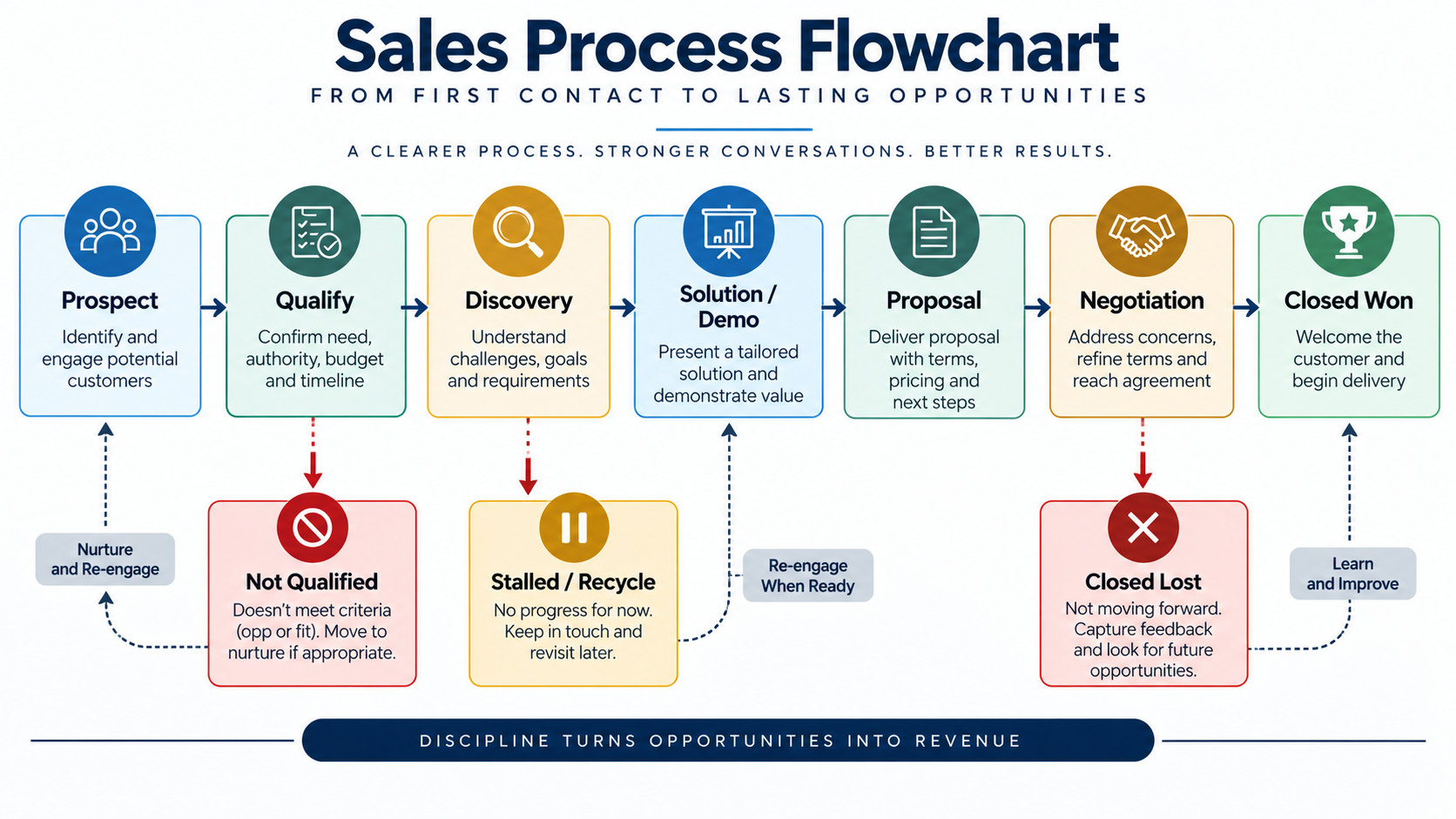
The visual does not need to be sophisticated. A sales process diagram succeeds when a rep can look at it and immediately understand where a deal belongs and what must happen next. If the chart requires interpretation, simplify it.
Pressure-test the flowchart against recent wins and losses. If a common real-world path is missing, add it. If a stage overlaps with another, merge it. The goal is a useful map, not a decorative slide.
How to Build a Sales Pipeline That Can Actually Predict Revenue
A scalable process eventually has to improve forecasting. The article How to Build a Sales Pipeline That Actually Predicts Revenue makes the core point clearly: a trustworthy pipeline is built around a clear definition of progress at every stage, not around optimism or default CRM fields.
Start with exits, not entries
When defining a stage, ask what must happen for a deal to leave it. “Customer is interested” is not an exit criterion. “Decision-maker attended the demo and agreed to review a proposal by Friday” is closer to something observable. Concrete exits force the pipeline to reflect buyer behavior.
Measure stage aging and conversion
Once the process has been used consistently long enough, measure how many opportunities move from one stage to the next, how long they remain in each stage, and where they are most likely to die. These numbers expose process bottlenecks. A low qualification-to-discovery conversion may indicate weak targeting or poor qualification. Long proposal aging may indicate that proposals are being sent without a committed review process.
Separate pipeline value from forecast confidence
A large pipeline can still be weak. Forecast confidence should be based on evidence: stage quality, buyer commitments, decision timing, qualification strength, stakeholder access, and historical conversion. The more consistently your team follows the process, the more meaningful those signals become.
Treat the pipeline as a planning tool
Do not update the pipeline only because management wants a report. Use it to run the week. Which opportunities need attention? Which next actions are overdue? Which deals are stuck? Which prospects should be removed? Which stage needs more top-of-funnel activity? A pipeline becomes predictive when it becomes operational.
The Sales Process for Small Business: Keep It Simple Enough to Use
Small businesses often make one of two mistakes: they have no process at all, or they copy an enterprise process that is too complicated for the team. A sales process for small business should be light enough to execute without a sales-operations department but disciplined enough to protect follow-up, qualification, and pipeline visibility.
A practical small-business version
Define the ideal customer and the problem you solve.
Use five to seven stages that reflect real buyer progress.
Set one or two non-negotiable exit criteria per stage.
Require a dated next action for every active opportunity.
Use a one-page sales process worksheet before building a large playbook.
Review the pipeline weekly and remove deals that no longer deserve active status.
Refine the process quarterly using wins, losses, and recurring objections.
The objective is not bureaucracy. It is to prevent the business from becoming dependent on one person’s memory. As volume grows, the same simple structure can be expanded into a fuller sales playbook and CRM workflow.
Common Mistakes When Building a Sales Process
Mistake 1: Designing the process around the CRM
Software should support the process, not define it. If you begin with whatever stages came preloaded in the CRM, you risk automating a workflow that does not match how customers buy.
Mistake 2: Using vague stage names without criteria
Labels such as “interested,” “hot,” or “proposal” mean different things to different reps. Replace subjective labels with observable evidence and clear exits.
Mistake 3: Treating qualification as optimism
A friendly conversation is not a qualified opportunity. Protect the pipeline from wishful thinking by requiring evidence of fit, need, authority, economics, and timing.
Mistake 4: Sending proposals without a next meeting
A proposal should advance a decision process, not begin a waiting process. Whenever possible, agree on how and when the proposal will be reviewed before sending it.
Mistake 5: Letting follow-up live in the inbox
An inbox is a communication channel, not a reliable commitment-management system. Every promised action needs a dated mechanism that surfaces it when it is due.
Mistake 6: Building a playbook nobody uses
If the playbook is too long, outdated, difficult to search, or disconnected from daily work, reps will ignore it. Build around real questions and keep one owner responsible for updates.
Mistake 7: Confusing activity with progress
Calls, emails, demos, and proposals are activities. Progress is a change in buyer commitment or evidence. The process should measure both, but it should never confuse the two.
Mistake 8: Never revising the process
Markets, products, buyers, competitors, and teams change. Review the process using real deal evidence. A scalable process is stable enough to create consistency and flexible enough to improve.
How to Implement the Process Without Creating Administrative Weight
Implementation is where a good design either becomes a system or becomes another forgotten document. The goal is to make the correct behavior easier than the old behavior.
1. Train the why before the fields
Reps need to understand why stage criteria, next actions, and qualification matter. If the rollout feels like management demanding cleaner CRM data, adoption will be shallow. Connect the process to fewer dropped deals, clearer priorities, better coaching, and less mental clutter.
2. Use real opportunities in training
Walk through current deals and ask where each one truly belongs. What evidence supports the stage? What is the next commitment? What would disqualify it? Real deals expose ambiguity faster than theoretical examples.
3. Make the workflow visible
Put the sales process flowchart, stage definitions, qualification criteria, and key playbook guidance somewhere reps can access quickly. The process should be a working reference, not a document people have to remember exists.
4. Coach to the process
Managers reinforce the system through the questions they ask. Instead of “How is Acme going?” ask “What evidence moved Acme into proposal? Who is involved in the decision? What is the next committed action and date?” Specific questions create specific behaviors.
5. Automate only after the process is stable
Automation can create reminders, tasks, sequences, alerts, and reporting, but automation multiplies whatever process you give it. Stabilize the logic first. Then automate the repetitive parts without automating judgment.
Metrics That Tell You Whether the Sales Process Is Scaling
A scalable process should make performance easier to understand. You do not need dozens of dashboards. Start with a small set of metrics that reveal volume, movement, speed, and quality.
New qualified opportunities created.
Stage-to-stage conversion rates.
Average time spent in each stage.
Overall win rate.
Sales cycle length.
Percentage of active opportunities with a dated next action.
Percentage of deals that meet qualification criteria.
Proposal-to-close conversion.
Closed-lost reasons.
Forecast accuracy.
The purpose of these measures is diagnosis, not surveillance. If stage conversion falls, ask what changed. If aging rises, find the bottleneck. If forecast accuracy is poor, examine stage definitions and qualification. Metrics are useful when they lead back to a process decision.
A 30-Day Plan for Building a Sales Process That Scales
Week 1: Map reality
Review recent wins and losses. Document the actual sales cycle steps, identify recurring buyer decisions, and draft five to seven stages. Do not polish the language yet.
Week 2: Define the rules
Write entry criteria, exit criteria, critical activities, qualification requirements, and follow-up expectations for every stage. Create the first sales process template and a simple sales process flowchart.
Week 3: Build the playbook layer
Add the practical guidance reps need: discovery questions, objection responses, email templates, proposal standards, examples, and tool instructions. Keep the first sales playbook template concise.
Week 4: Run, review, and refine
Use the process on every active opportunity. Hold a weekly pipeline review. Note where the team disagrees about stage placement or next actions. Those disagreements reveal where definitions need improvement.
At the end of thirty days, you will not have a perfect system. You should have something more valuable: a process grounded in real deals, tested by real reps, and clear enough to improve.
Final Checklist: Is Your Sales Process Ready to Scale?
Can every rep explain the stages of a sales process in the same way?
Does each stage have objective entry and exit criteria?
Does every active deal have a dated next action?
Is qualification based on evidence rather than enthusiasm?
Do proposals and demos connect directly to discovery?
Are common objections and responses documented?
Can a manager coach a deal by looking at the process and evidence?
Does the sales playbook answer real rep questions quickly?
Does the sales process flowchart show stalled, nurture, won, and lost paths?
Are pipeline stages based on buyer progress?
Can you measure conversion and aging by stage?
Does the team review and improve the process on a regular rhythm?
Conclusion: A Scalable Sales Process Replaces Heroic Effort With a System
The biggest advantage of a defined sales process is not that it makes selling rigid. It makes selling repeatable. Reps spend less energy deciding what to do next. Managers coach with more precision. Weak opportunities are exposed earlier. Follow-up becomes visible. The pipeline becomes more trustworthy. Best practices can be taught instead of trapped inside the heads of a few experienced people.
Start with the fundamentals: define the sales process steps, establish meaningful sales pipeline stages, set qualification standards, and attach a dated next action to every legitimate opportunity. Then document the system in a sales process template, expand it into a sales playbook, and make the logic visible with a sales process flowchart.
Do not wait for a perfect version. Build the first process from the way your best deals actually move, test it against real opportunities, and improve it with evidence. That is how to create a sales process that scales: not by adding bureaucracy, but by turning the behaviors that produce results into a system your team can execute consistently.
Related Sales Process Resources
What Is a Sales Process? A Simple Definition for Business Owners
7 Essential Sales Process Steps Every Business Should Have
How to Create a Sales Process From Scratch
Free Sales Process Template: Build Your Playbook in Under an Hour
Understanding Sales Pipeline Stages: From Lead to Closed Deal
Real-World Sales Process Examples
The B2B Sales Process Explained: How It Differs From B2C
What Is a Sales Playbook and Why Your Team Needs One
How to Build a Sales Playbook Template That Reps Actually Use
How to Create a Sales Process Flowchart That Simplifies Selling
Sales Qualification Process: How to Spot a Good-Fit Lead
Lead Qualification Framework: Stop Chasing the Wrong Prospects
What Is BANT Sales? A Simple Framework for Qualifying Leads
Sales Process vs. Sales Methodology
How to Build a Sales Pipeline That Actually Predicts Revenue