
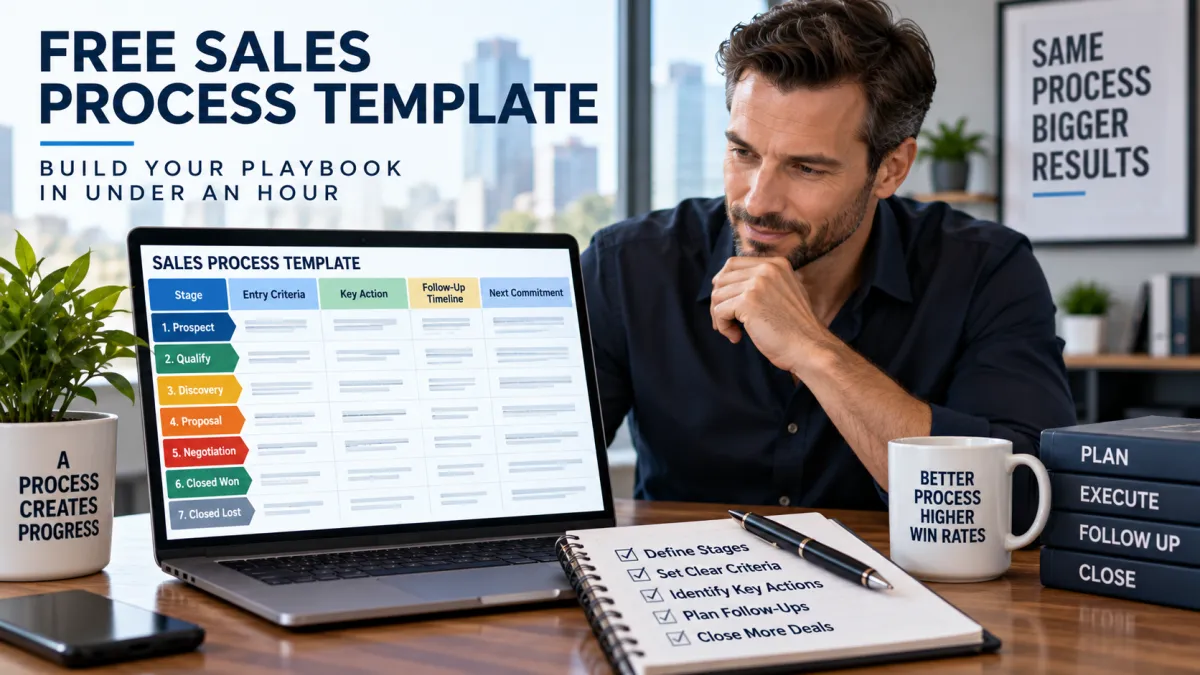
Free Sales Process Template: Build Your Playbook in Under an Hour
Most salespeople don't lose deals because they can't sell. They lose deals because they're inconsistent — following up with some prospects but not others, advancing some opportunities but stalling on the rest.
A sales process template won't close deals for you. But it will stop you from leaving them on the table by accident.
Why Most Salespeople Skip the Process
You already know how to sell. So building a formal process feels like paperwork — something for managers, not quota-carriers.
But here's the problem: without a written process, every deal runs on memory. And memory is the least reliable system you have when you're managing thirty active opportunities across fifteen accounts.
The reps who consistently hit quota aren't necessarily better at selling. They're better at repeating what works — and a good documented sales process is how they do it.
What a Sales Process Template Actually Gives You
Think of a sales process template as a short playbook — a written record of the steps, actions, and decision points that move a deal from first contact to closed.
At minimum, a useful template covers:
Your defined stages (with clear entry and exit criteria)
The key action required at each stage
The follow-up trigger and timeline
The next commitment to be confirmed before moving forward
That's it. Four columns. One row per stage. You don't need a 40-page binder — you need something you'll actually use.
Build Your Sales Process Template in Under an Hour
Open a spreadsheet or a blank document. Then work through these questions for each stage of your typical deal:
What has to be true before this stage begins? Define the entry criteria so you stop moving deals forward prematurely.
What's the single most important action at this stage? One action, not a list. If you can't name it, the stage isn't defined clearly enough.
What does the prospect need to do or agree to before you advance? Every stage should end with a confirmed next step — not a vague "I'll think about it."
What's your follow-up timeline if you don't hear back? Write the number of days. Then put it on your task list — not in your head.
Most reps finish a working draft in thirty to forty-five minutes. The second pass — where you refine based on what actually happens in the field — takes another fifteen.
Turn Your Template Into a Daily System
A sales playbook template only creates results when it connects to how you actually manage your day. That means your follow-up timelines need to live somewhere you'll act on them — not buried in a CRM you check once a week.
This is where Microsoft Outlook becomes the execution layer. Tasks tied to deal stages, calendar blocks for planning, and a clean inbox that surfaces only what needs attention today — that combination turns a static template into a live system.
Sell Sm@rter with Microsoft Outlook is a complete sales productivity system built around exactly that workflow — connecting your process to your tools so nothing falls through the cracks.
Start With What You Have
You don't need a perfect process. You need a written one.
Download a free sales process worksheet, map your current stages, and commit to running every new opportunity through it for thirty days. You'll close more of what you're already working — without adding a single new lead to your pipeline.
Start with the template. Build the habit. Then refine as you go.