
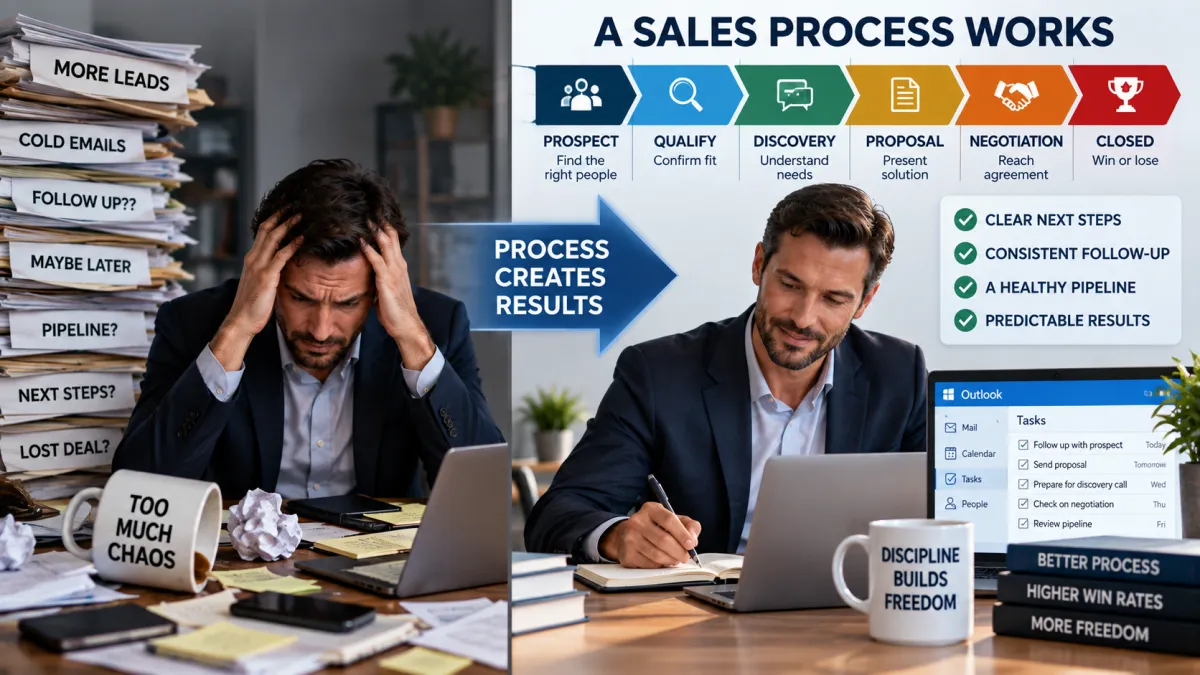
How to Create a Sales Process From Scratch: A Step-by-Step Guide
Most salespeople don’t lose deals because they lack talent. They lose deals because they lack a repeatable process — and they don’t realize it until the quarter is already over.
Why You Need a Sales Process Before You Need More Leads
Adding more leads to a broken process just creates more chaos. If you can’t predict what happens after a first conversation, you’re not running a pipeline — you’re managing a wishlist.
A defined process gives you control. It tells you exactly where every opportunity stands, what the next step is, and when to follow up. Without it, you’re relying on memory and luck.
How to Create a Sales Process in Five Steps
Step 1: Define Your Stages
Map out the stages a prospect moves through from first contact to closed deal. Keep it simple — five to seven stages is usually enough. Think about what actually happens in your sales cycle, not what looks good in a CRM.
Common stages: Prospect, Qualify, Discovery, Proposal, Negotiation, Closed Won/Lost.
Step 2: Assign a Clear Exit Criteria to Each Stage
A stage without an exit criteria is just a label. Define what has to happen before a deal moves forward. This is what separates a real process from a guessing game.
Example: A deal doesn’t move from Qualify to Discovery until you’ve confirmed budget, authority, and a business problem worth solving.
Step 3: Identify Your Key Activities
For each stage, list the two or three actions that consistently move deals forward. These are your process-critical activities — the ones that, when skipped, stall opportunities and kill momentum.
Step 4: Build Your Follow-Up System
This is where most salespeople fall apart. Building a sales process means nothing if follow-up depends on memory. Every commitment needs a home — a task with a date, not a sticky note or an unread email.
If you use Microsoft Outlook, your task list and calendar are your system. Use them deliberately. An inbox is not a to-do list.
Step 5: Create a Weekly Review Habit
Your process only improves if you look at it. Once a week, review your pipeline by stage. Identify stalled deals, overdue follow-ups, and gaps in your activity. Adjust before the problem compounds.
A Note on Tools
You don’t need expensive software to start. When you’re learning how to develop a sales process, the thinking matters more than the technology. Get the stages and activities right first. Then choose tools that support the process — not the other way around.
For a deeper look at building a sales process that scales as your territory or team grows, that guide walks through each element in detail.
Start Simple. Stay Consistent.
The best sales process is the one you will actually use. Start with five stages and one clear follow-up system. Run it for ninety days. Then refine it.
If you want a productivity system that supports your sales process — one built specifically around Microsoft Outlook — Sell Sm@rter with Microsoft Outlook gives you the framework to manage your pipeline, your follow-up, and your day without letting your inbox run the show.
The process is the foundation. Build it first.